

A Timbro – EPICENTER initiative.
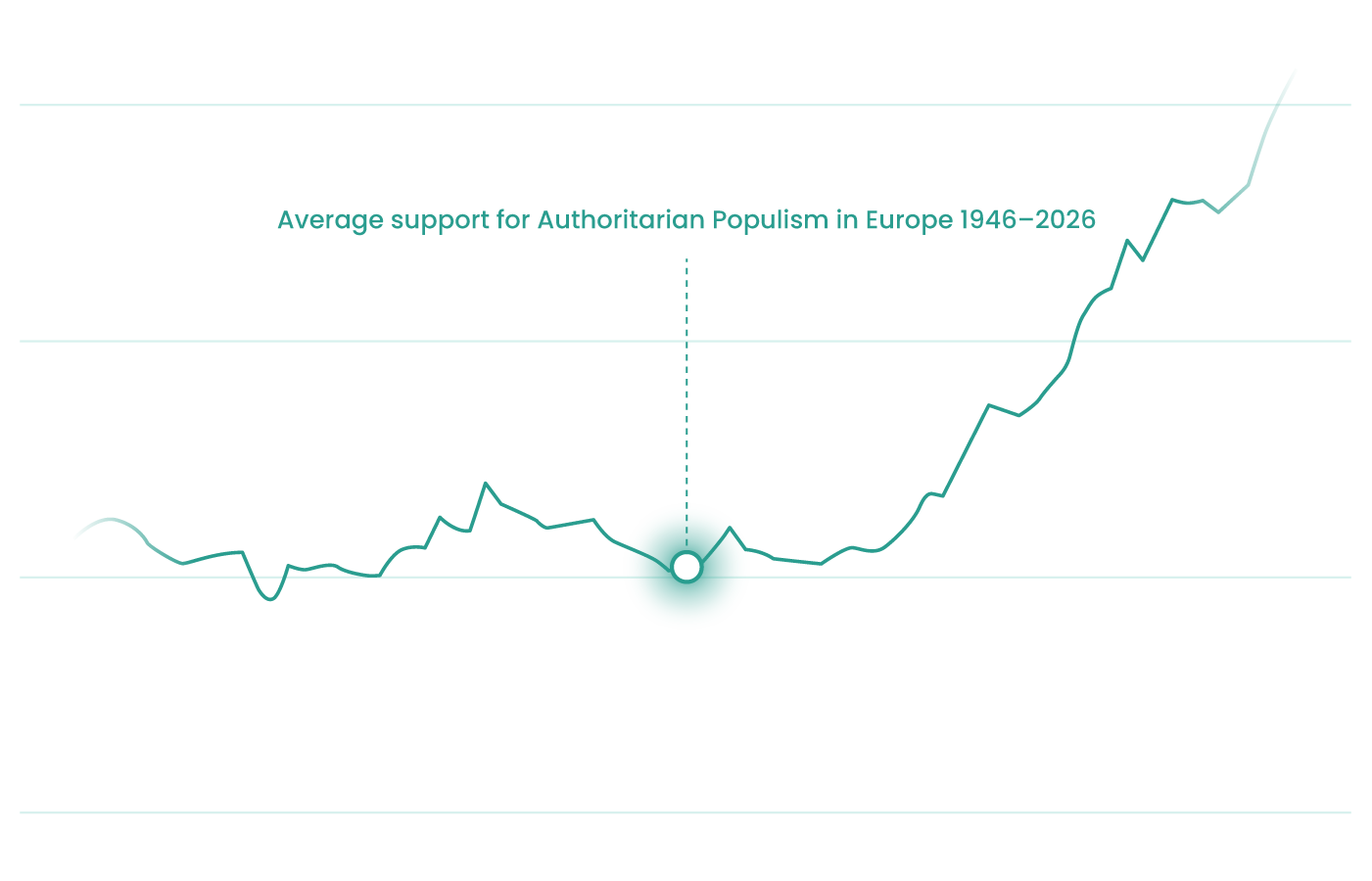
Almost one in three European voters now backs a challenger party, the highest level on record. The radical right has driven most of the rise and remains close to its record high.
This website was funded by the Friedrich Naumann Foundation for Freedom – Europe.
Combined support for populist and authoritarian parties has surpassed 30% for the first time, reaching 32.6% in 2026. Challenger parties now attract roughly three times as many voters as they did during most of the post-war era. The radical right has been the main driver of this rise, while left-wing challenger parties have seen a modest uptick in recent years.
About the index
A comprehensive overview of the major ideological trends in European politics, focusing on parties advocating illiberal and authoritarian ideologies.
The Authoritarian Populism Index maps ideological trends in European politics, tracking parties that pose a challenge to liberal democracy, the market economy and the rule of law. First published in 2016, the index now covers more than 260 parties in 31 European democracies, with in-depth analysis of the 76 most relevant parties, and with electoral data spanning from the first post-war elections to 2026. The 2026 edition – the fifth in the series – substantially expands its comparative analysis of individual parties, examining their positions on economics, social issues, EU membership and democratic norms. It also traces what happens when challenger parties enter government, and how their stances on Russia and the United States have become a new dividing line within the European radical right.
2016
first published
5th
edition — updated, revised and expanded
31
countries covered
1945-2026
every election
Choose country
Populism rank
Main findings
Twelve headlines from 31 countries and 80 years of election data.
From the first post-war elections until the late 1990s, combined support for challenger parties held steady at around 10% across Europe. That changed around the turn of the millennium. By 2026, support has surpassed 30% for the first time, driven mainly by the continued advance of the radical right.
The overall trend masks significant variation. In Bulgaria, Czechia, Romania, Italy and Slovakia, challenger parties now attract more than half of all voters. In 26 of the 31 democracies covered, they win more than 20% of the vote. Malta is the one outlier, with no parliamentary challenger parties at all. Seven of the ten countries with the highest support are post-communist democracies.
Support for challenger parties on the right has increased steadily for more than three decades, reaching new highs in most years of the 2020s and peaking at 21.3% in 2025. In 20 of the 31 countries, support for the radical right increased in the latest election. The most striking feature of this wave is not each new record but its resilience.
After a sharp decline following the collapse of communism, left-wing challenger parties have recovered in recent years, and in France the next presidential election may pit the radical left against the radical right. Unlike the radical right, however, the radical left has failed to sustain an upward trajectory, and in 13 of the 31 countries it won less than 1% of the vote in the latest election.
By summer 2026, challenger parties participated in 11 of the 31 governments covered by the index – more than one in three. Since 2000, around 45 different governments have included one or more challenger parties. Only six countries have never had a radical-left or radical-right challenger party in national government: Germany, Ireland, Malta, Portugal, Sweden and the United Kingdom.
Christian democratic parties have declined steadily since the mid-1970s, with average support falling to around 6.5% in 2026. They now win measurable support in only 13 of the 31 countries. Conservative parties have proved more durable: their support peaked at above 20% around 2010 and stands at 17.1% in 2026.
Social democratic parties once commanded the largest vote shares in most European countries. Between 2001 and 2026, their average support fell from around 28% to 16%. Only in Malta, the United Kingdom and Spain do they still receive more than 30% of the vote.
Unlike Christian democratic and social democratic parties, liberal parties have not emerged as long-term losers. After a dip in the early 2000s, their support recovered to a record 12.3% in 2022 and 2023. In 2026, they attract 11.5% – a modest decline, not a collapse. They are strongest in Estonia (more than 44%) and also exceed 20% in Slovenia, Slovakia, Belgium, Switzerland and France.
Government participation can force radical parties to moderate: the Sweden Democrats accepted NATO membership and dropped their EU-exit position; the Finns Party committed firmly to EU cooperation, NATO and sanctions against Russia. But the process can also run in reverse. There is no automatic answer to whether cooperation strengthens or weakens challenger parties. At least three outcomes are possible: moderation, radicalisation, or mainstream adoption of the challenger agenda without the challenger joining government.
Most challenger parties have moved from demanding exit to demanding reform. All but two of the 76 parties, Brothers of Italy and PSD, can be described as eurosceptic in some sense, and none advocates a substantial further transfer of power to the EU level. Twenty are classified as hard eurosceptic. Brothers of Italy is the clearest example of the shift: rooted in a strongly sovereigntist tradition, it has accepted the euro in government and abandoned any suggestion of leaving the Union. Jordan Bardella put it plainly: 'We do not wish to leave the European Union. We wish to change everything without destroying anything.'
Challenger parties almost invariably present themselves as democratic. The question is how they understand the limits of majority power, judicial independence, media freedom and minority rights. Of the 76 parties analysed, 18 are classified as highly authoritarian, including Fidesz, PiS and Smer, which have shown in government how far they are prepared to go in weakening checks and balances.
Russia's full-scale invasion of Ukraine in 2022 forced many challenger parties to distance themselves from Moscow. The second Trump presidency has reinforced a transatlantic nationalist network but also exposed divisions. Parties firmly committed to NATO and Ukraine sit uneasily alongside Russia-friendly parties such as Austria's FPÖ. Attitudes towards Putin and Trump have become useful indicators of where challenger parties stand on liberal democracy.
Electoral support for challenger parties has reached record levels in 2026
Populist and authoritarian parties pose a challenge across all of Europe
The rise of the radical right has not slowed down
The populist left rises again
Challenger parties have become a normal part of government
Christian democrats are the main losers on the mainstream right
Social democratic parties have lost more than four in ten voters since 2000
Liberal parties are not long-term losers
Moderation is not an automatic consequence of government participation
Euroscepticism is weakening, at least temporarily
Authoritarianism is still the main reason for concern
Relations with Russia and the United States have become new dividing lines
Government participation
By summer 2026, challenger parties participated in 11 of the 31 governments covered by the index.
Bulgaria
Croatia
Czechia
Finland
Iceland
Italy
Latvia
Slovakia
Slovenia
Spain
Switzerland
The 76 most relevant parties, classified

Economic axis
27 left, 23 centre, 26 right

Cultural axis
53 conservative, 8 moderate, 15 progressive

European axis
20 hard eurosceptic, 54 soft eurosceptic, 2 pro-European

Authoritarianism
18 high, 33 medium, 25 low
Performance in government varies widely. Fidesz, Law and Justice (PiS) and Direction – Social Democracy (Smer) have proven unreliable defenders or outright opponents of liberal democracy, while the Finns Party (PS) and Brothers of Italy (FdI) have so far worked within existing structures.